


Bearings
Pumps
Rotors
Wheels
Seals
Couplings
Modernization of the synthesis gas turbocompressor at the Ammonia Production Unit of JSC MAXAM-CHIRCHIQ (Chirchik, Uzbekistan)
In the 1970s, 42 chemical industry plants for the production of ammonia and other mineral fertilizers were built. During the period of rapid development of ammonia synthesis technology worldwide (1970–1990), the main supplier of dynamic equipment was the Japanese company Toyo Engineering Corporation (TEC).
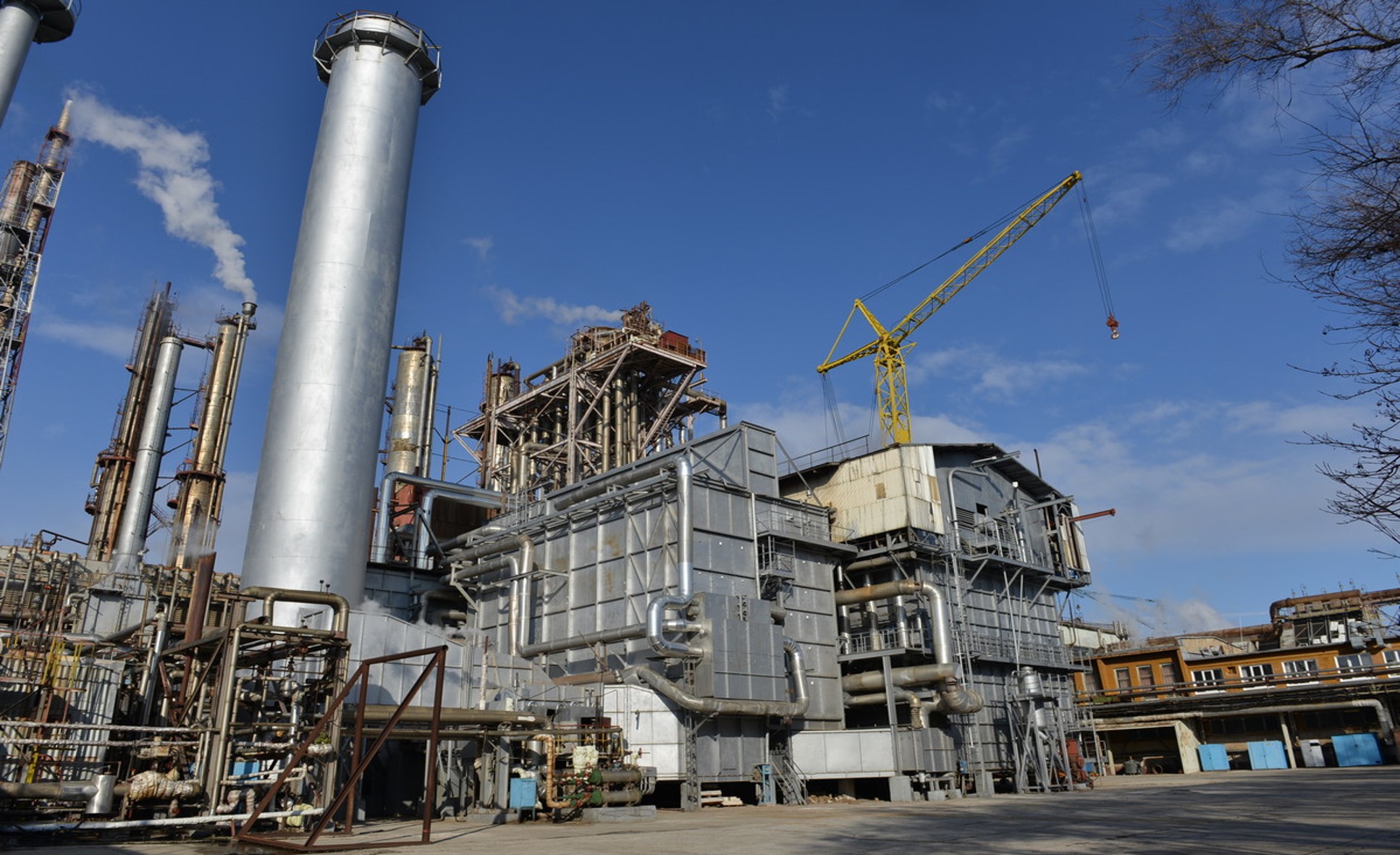
As part of the process equipment for large-scale ammonia production (1,360 t/day), the most structurally complex unit is the synthesis gas turbocompressor train, which includes a centrifugal compressor consisting of low-pressure (LPC), medium-pressure (MPC), and high-pressure (HPC) casings, along with a drive condensing steam turbine (ST).
For centrifugal compressors, TEC used equipment from Dresser-Clark (USA), and later from Mitsubishi Heavy Industries Compressor Corporation (Japan) under license from Dresser-Clark, while the STs were manufactured by Mitsubishi Heavy Industries (Mechanical Drive). Between 1972 and 1975, under license from Dresser-Clark, the production of LPC, MPC, and HPC compressors was mastered by Kazan-based enterprises CJSC “NIIturbokompressor” and OJSC “Kazankompressormash”.
The prolonged service life of the equipment led to a decrease in the efficiency of compression processes in turbocompressors and energy generation in turbines. More than 50 years after the development of the original designs and the commissioning of synthesis gas turbocompressors, new structural and process solutions have been created to significantly improve equipment efficiency.
In the 2000s, as the design life of synthesis gas turbocompressors approached exhaustion, extending the operating life of the installed units and increasing mean time between overhauls through modernization became critical tasks to prevent emergency shutdowns and enhance the efficiency of ammonia production.
Increasing ammonia production efficiency by expanding unit capacity led to changes in compressor operating modes and a significant rise in gas-dynamic loads on the rotors. Implementing technical solutions without considering all process factors and the interdependence of operating parameters led to reduced reliability in synthesis gas turbocompressor operation.
-
Improving the reliability and cost-efficiency of synthesis gas compressor trains is an urgent task for the following reasons:
- • Exceeding the specified operational design life;
- • Inconsistency of compressor and drive turbine efficiency with modern technical standards;
- • Substantial shifts in the operating conditions of synthesis gas turbocompressors;
- • Lack of redundant/standby compressor equipment;
- • Increased failure rates of critical components (couplings, bearings, seals, etc.), resulting in unplanned downtime and substantial financial losses;
- • Standard original components (bearings, floating ring end seals, labyrinth seals, gear couplings) and partial modernizations fail to ensure a 2-year continuous operating cycle between overhauls.
Modernizations of the synthesis gas compressor carried out by Dresser-Clark were implemented at several chemical plants to increase capacity from 1,360 to 1,800 t/day. During these modernizations, the rotor and the internal casing of the medium- and high-pressure sections were replaced. The low-pressure casing was not modernized. Operating these modernized compressor trains across various plants revealed that the low-pressure casing operates outside its stable operating envelope (damping forces are insufficient to suppress excitation forces) and is characterized by high vibration levels. Absolute vibration amplitudes reach up to 12 mm/s. Vibration analysis of the casing indicates the presence of a sub-synchronous low-frequency component in the vibration spectrum. The root cause of this high vibration is rotor whirl/instability. Instability occurs in machines where the rotor operating speed equals or exceeds twice the first critical speed, resulting from aerodynamic cross-coupling forces amplified by increased throughput and circulatory forces within labyrinth seals. This instability manifests as self-excited subsynchronous rotor vibrations near the first critical frequency, meaning the rotor operates in an unstable zone under normal process conditions. Operating the low-pressure casing in this mode leads to the destruction of standard bearings and floating ring seals, as well as severe wear of flow-path labyrinth seals, which increases inter-stage gas recycling and degrades overall casing compression efficiency.
A prime example of deep modernization of a large-capacity ammonia synthesis gas compressor that achieved high reliability and efficiency is the implementation of a proprietary technical package by TRIZ, Ltd. at JSC “Maxam-Chirchiq” (Chirchiq, Uzbekistan) in 2025.
The “Ammonia-1” plant operated a classic large-scale ammonia production unit built according to TEC technology and the Soviet AM-76 design line. The core of the process is the synthesis gas turbocompressor train consisting of Dresser-Clark type compressors (Pos. 401) driven by a Mitsubishi Heavy Industries condensing steam turbine (Pos. 103-JT).
-
Over a long service period, the synthesis gas turbocompressor train regularly encountered typical operational issues:
- • Low-frequency vibration (LFV) in the low-pressure casing (LPC);
- • Severe resonance and harsh transitions through critical speeds;
- • Unplanned emergency shutdowns triggered by high LPC vibration trips;
- • Turbine axial rotor displacement due to insufficient load-carrying capacity of the original thrust bearing, etc.
The necessity to ramp up production capacity to enhance plant efficiency by modifying turbocompressor characteristics, as well as resolving the operational issues listed above, led to the collaboration between TRIZ, Ltd. and JSC “Maxam-Chirchiq” for a comprehensive modernization of the compressor train (redesigning the flow paths of the Pos. 401 compressors and the 103JT steam turbine).
-
Modernization Objectives:
- • Expand the ammonia production range from 1,360 to 2,000 metric tons per day;
- • Increase compressor polytropic efficiency up to 74% at an optimum capacity of 1,750 tons per day;
- • Reconstruct the steam turbine to match new compressor parameters while simultaneously increasing turbine efficiency;
- • Reduce specific natural gas consumption per ton of ammonia produced;
- • Extend the overhaul run interval from 1 year to 2–6 years.
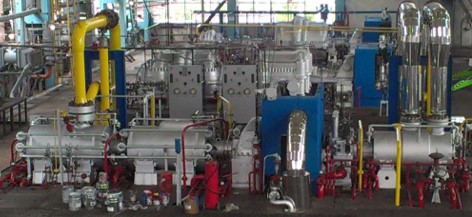
Synthesis Gas Turbocompressor Train Pos. 401.
As part of the large-scale capacity expansion program for the “Ammonia-1” shop at JSC “Maxam-Chirchiq”, TRIZ, Ltd. (General Contractor) in partnership with General Electric (GE) (Subcontractor) executed a turnkey turbocompressor modernization project.
- During the upgrade, original OEM components were replaced with high-reliability engineered assemblies developed by TRIZ, Ltd.:
- • LPC, MPC, and HPC aerodynamic flow-path assemblies with anti-swirl dimpled labyrinth seals;
- • Steam turbine flow path;
- • Damped hydrodynamic journal and combined journal-thrust bearings;
- • Oil-lubricated floating ring end shaft seals;
- • MSK-type flexible membrane couplings.
GE executed the redesign of the turbine flow path, replacing original journal and combined journal-thrust bearings with high-load bearing assemblies supplied by TRIZ, Ltd.
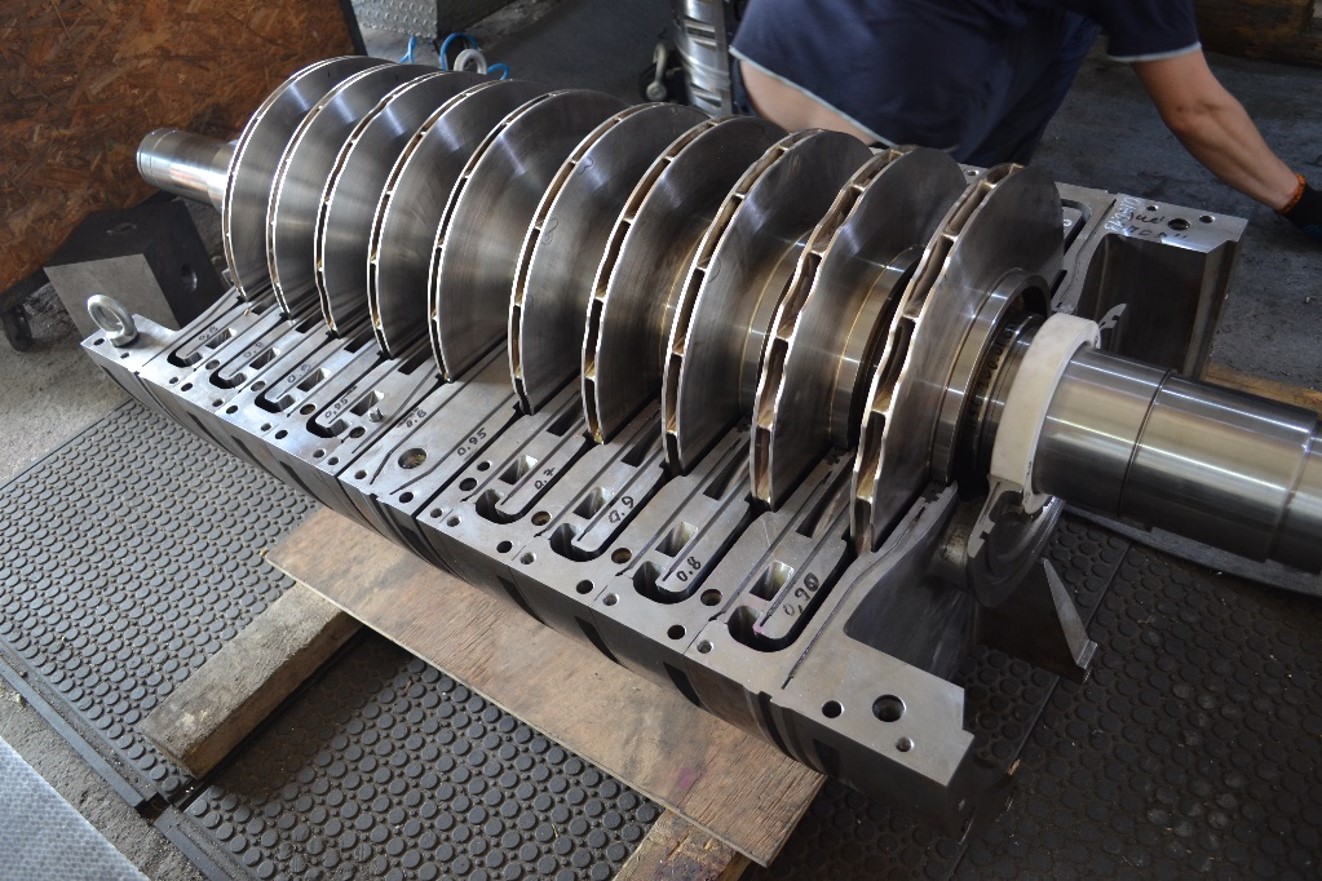
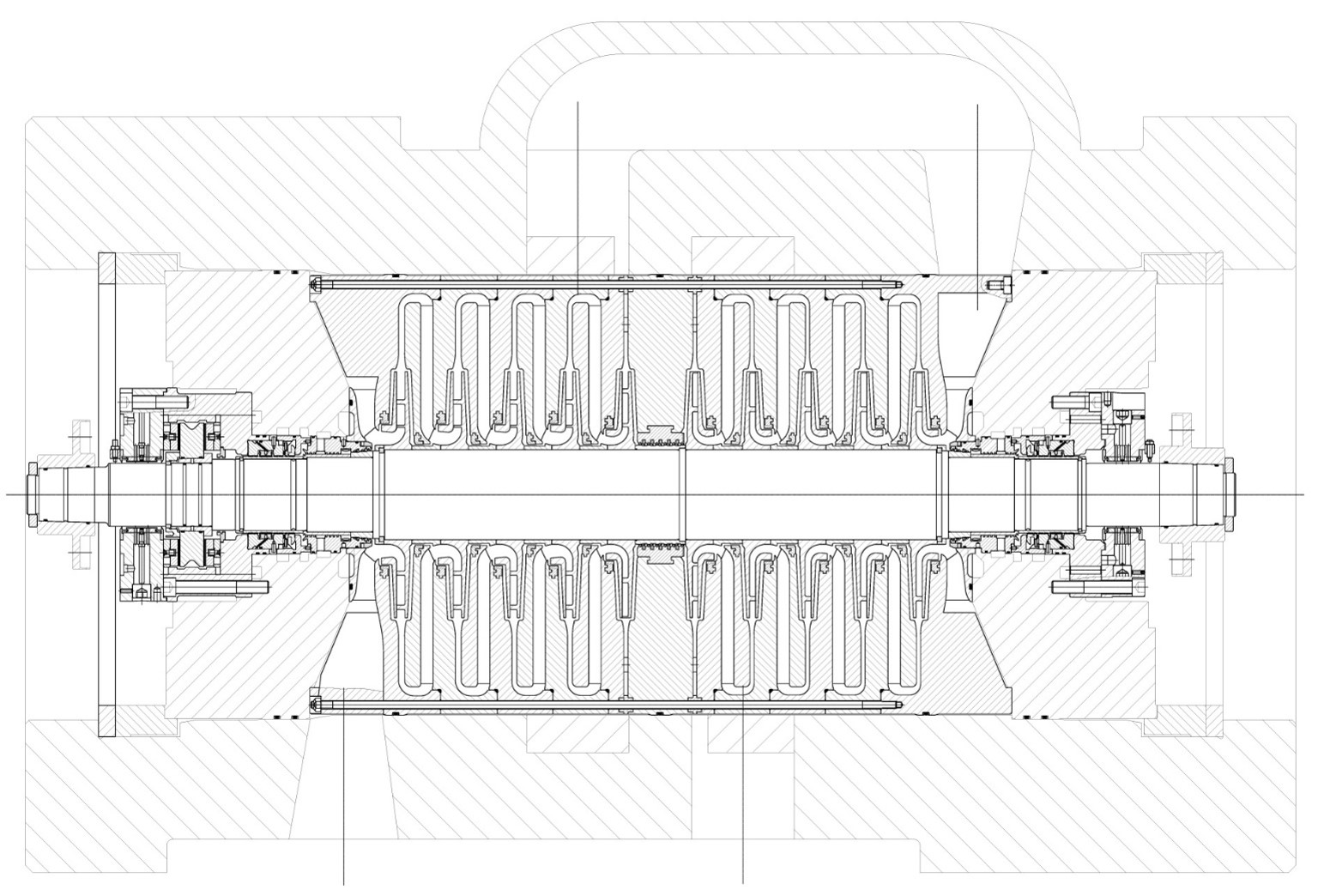
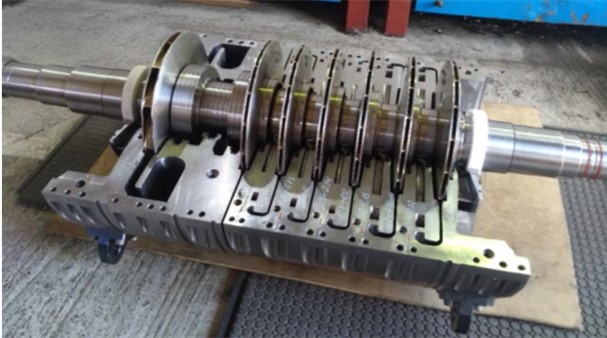
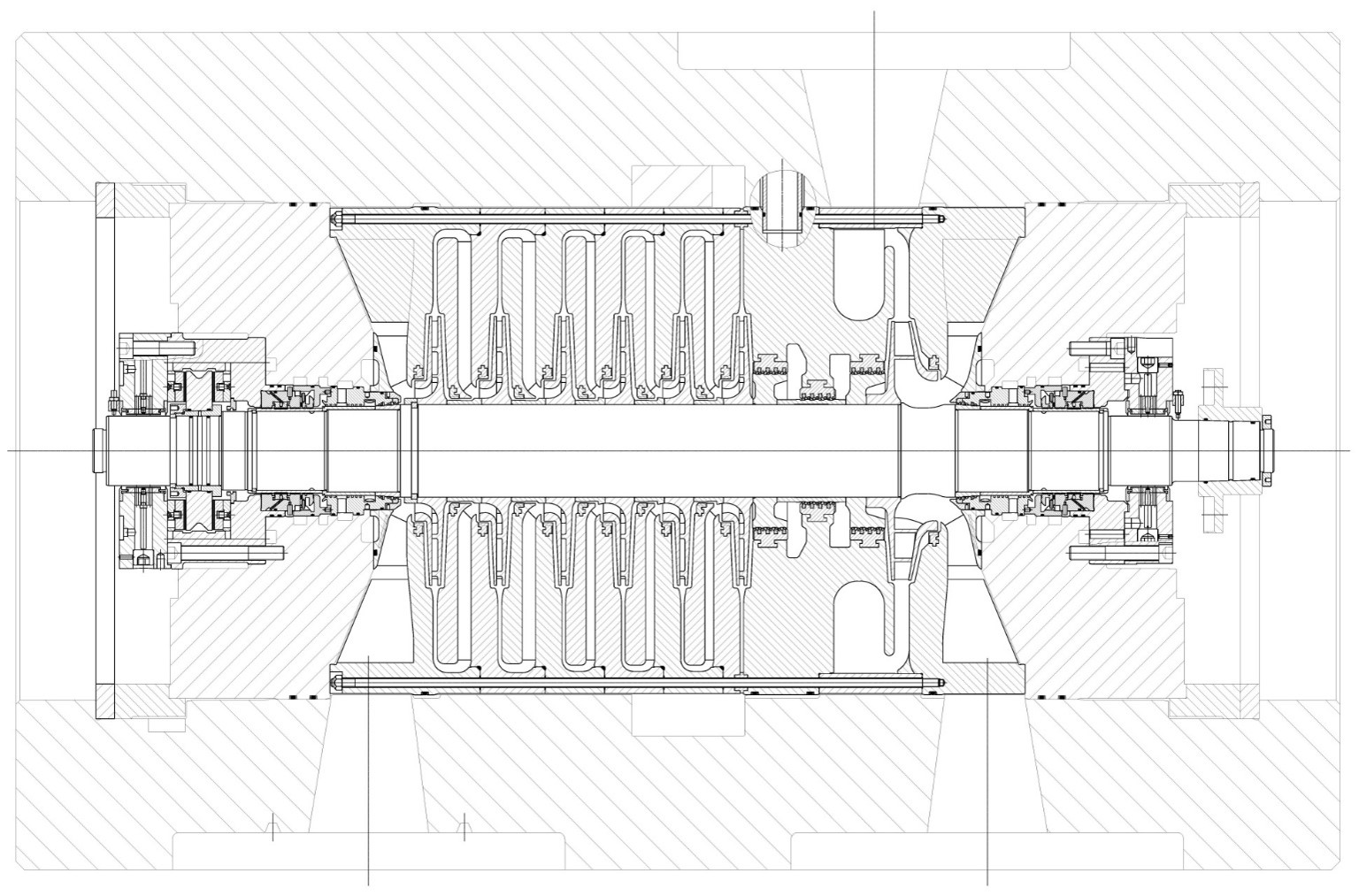
Aerodynamic Bundles: To boost efficiency and dynamic stability, OEM aerodynamic bundles in the LPC, MPC, and HPC were completely replaced with upgraded proprietary designs by TRIZ, Ltd. The geometry of internal diaphragms/casings and rotor impellers was recalculated for the new gas flow regime, optimized for a target output of 1,750 t/day of ammonia.
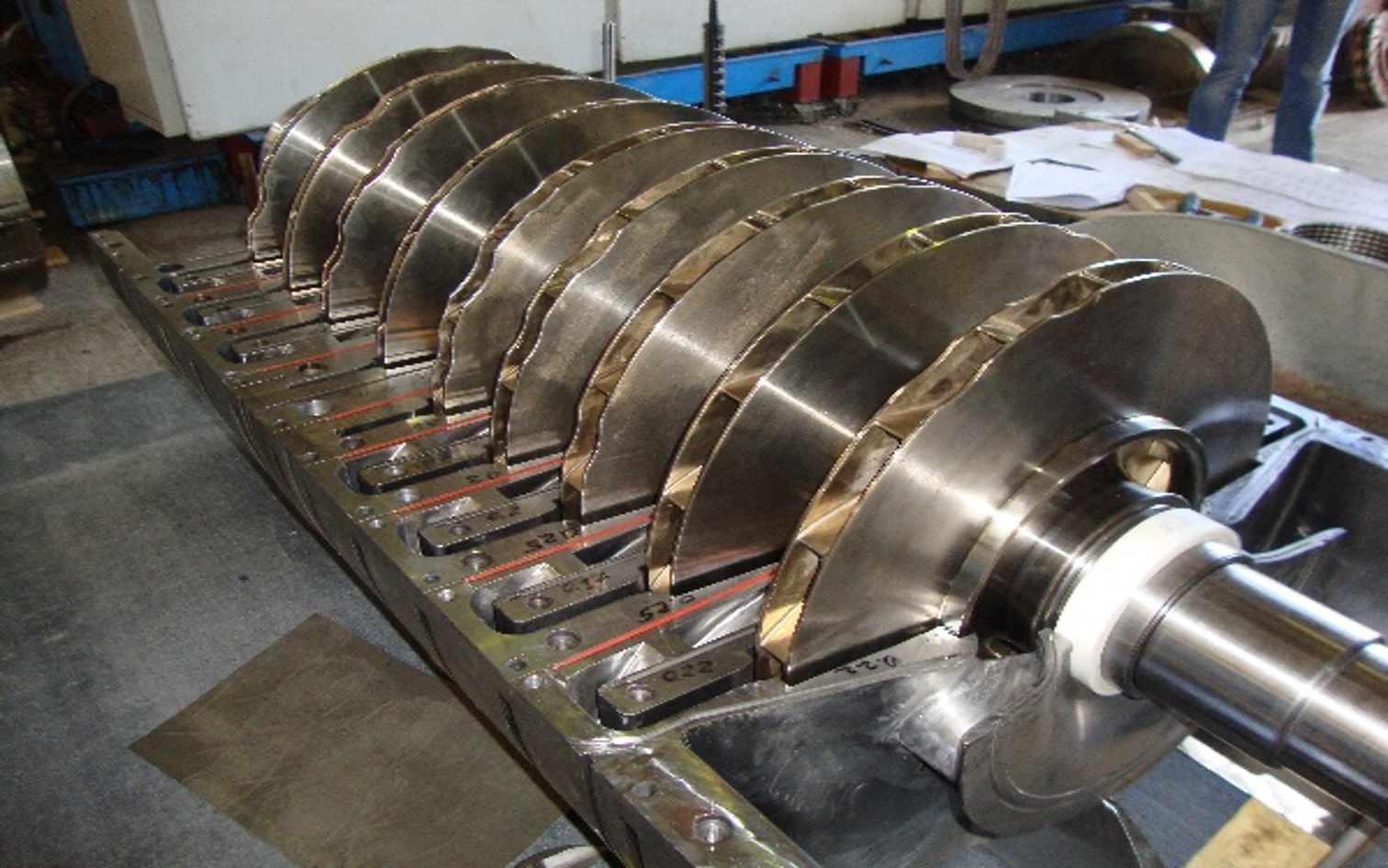
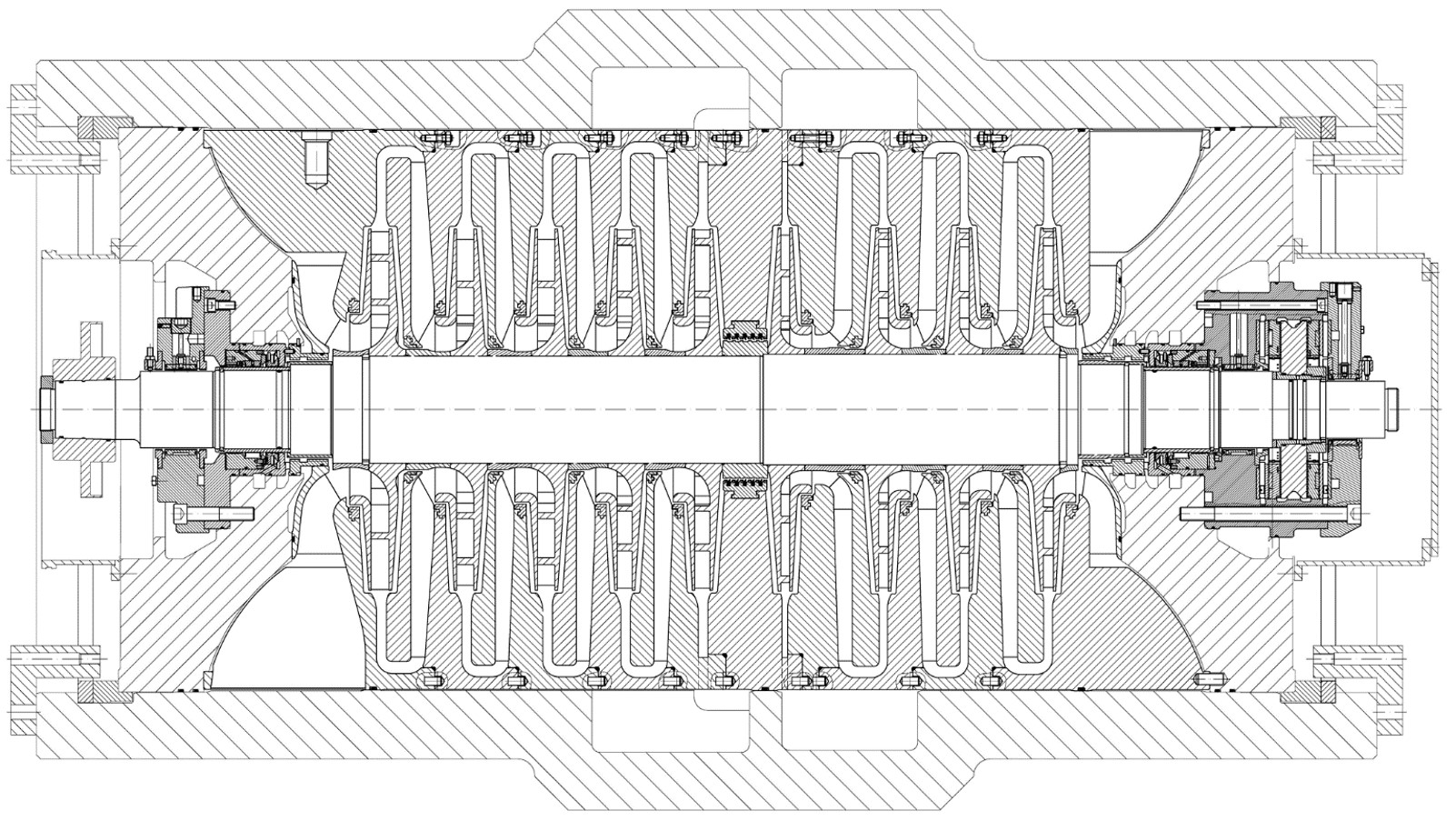
Upgraded Low-Pressure Compressor Flow Path
Upgraded Medium-Pressure Compressor Flow Path
Upgraded High-Pressure Compressor Flow Path
Steam Turbine Flow Path: GE (General Electric) reconstructed the steam turbine, fitting it with high-reliability journal and thrust bearings to fully match its rotordynamic behavior with the upgraded compressors.
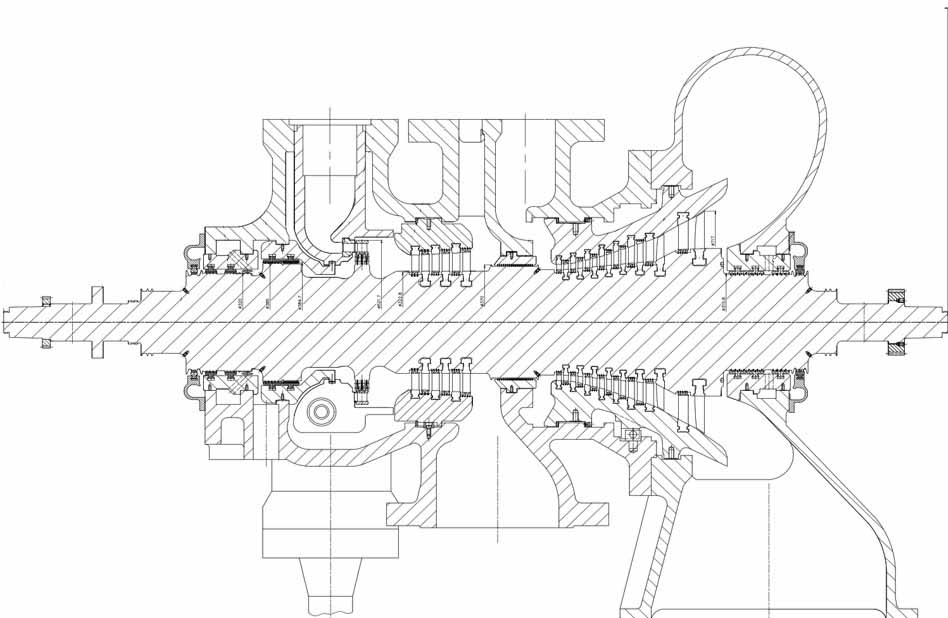
Upgraded Steam Turbine Flow Path
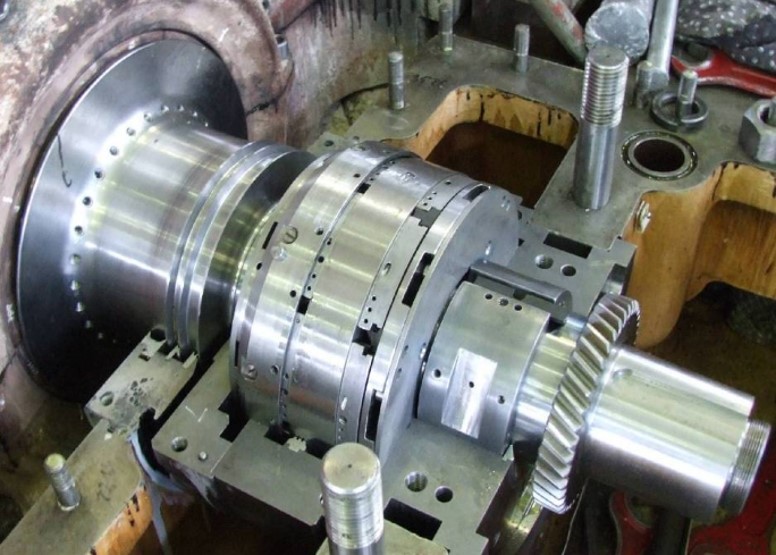
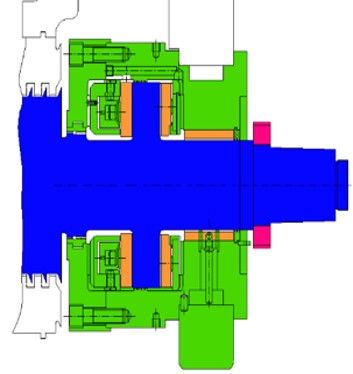

Turbine Bearings Manufactured by TRIZ, Ltd.
Journal Bearings: Original 5-pad tilt-pad journal bearings in the compressors were replaced with TRIZ, Ltd. proprietary 3-pad damped hydrodynamic bearings supported on self-generating hydrostatic oil squeeze-films.
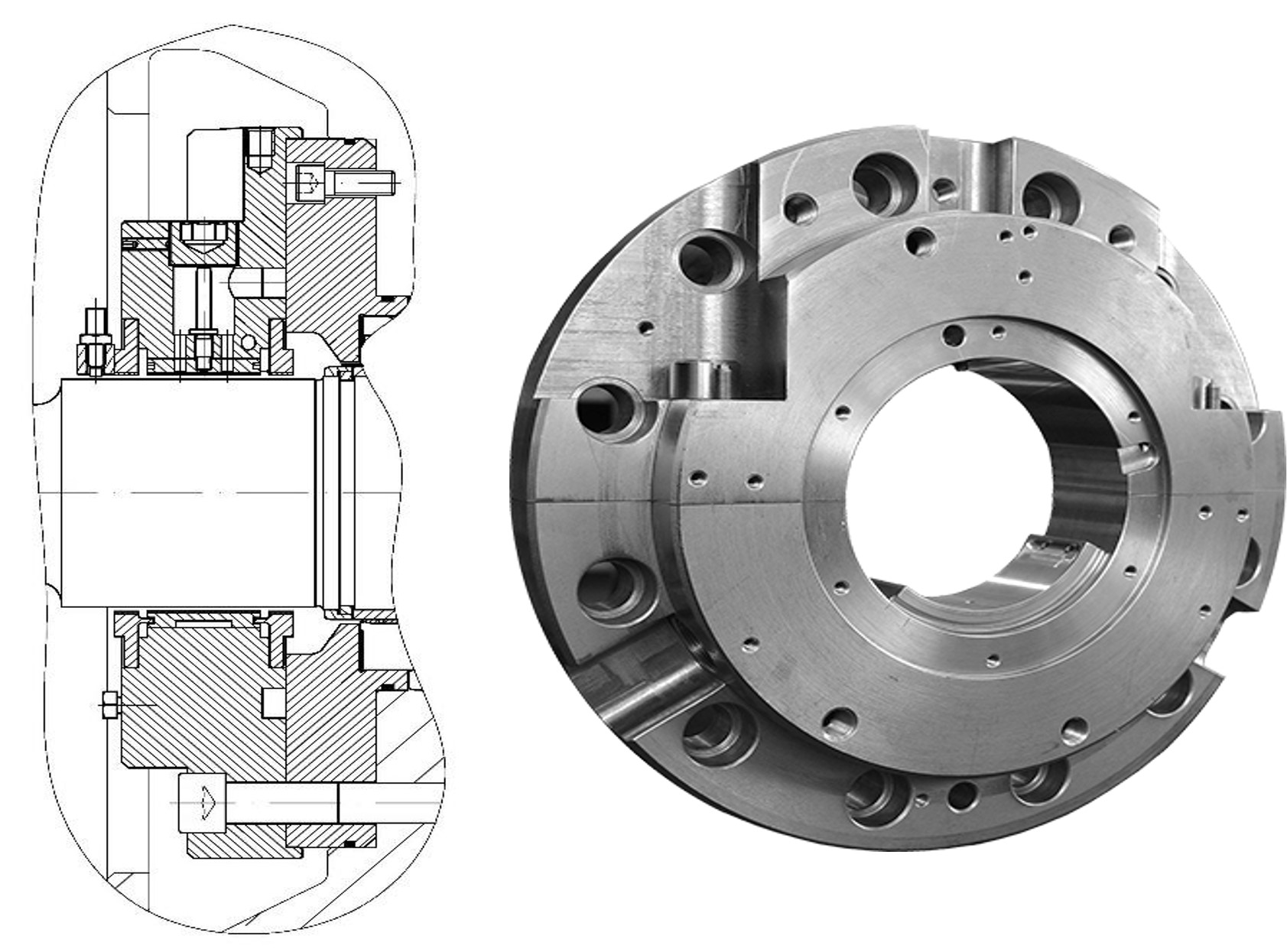
Combined Journal-Thrust Bearings: Standard compressor thrust bearings were replaced with damped journal-thrust bearings providing double the axial load-carrying capacity margin in accordance with API standards and delivering highly effective radial vibration attenuation.
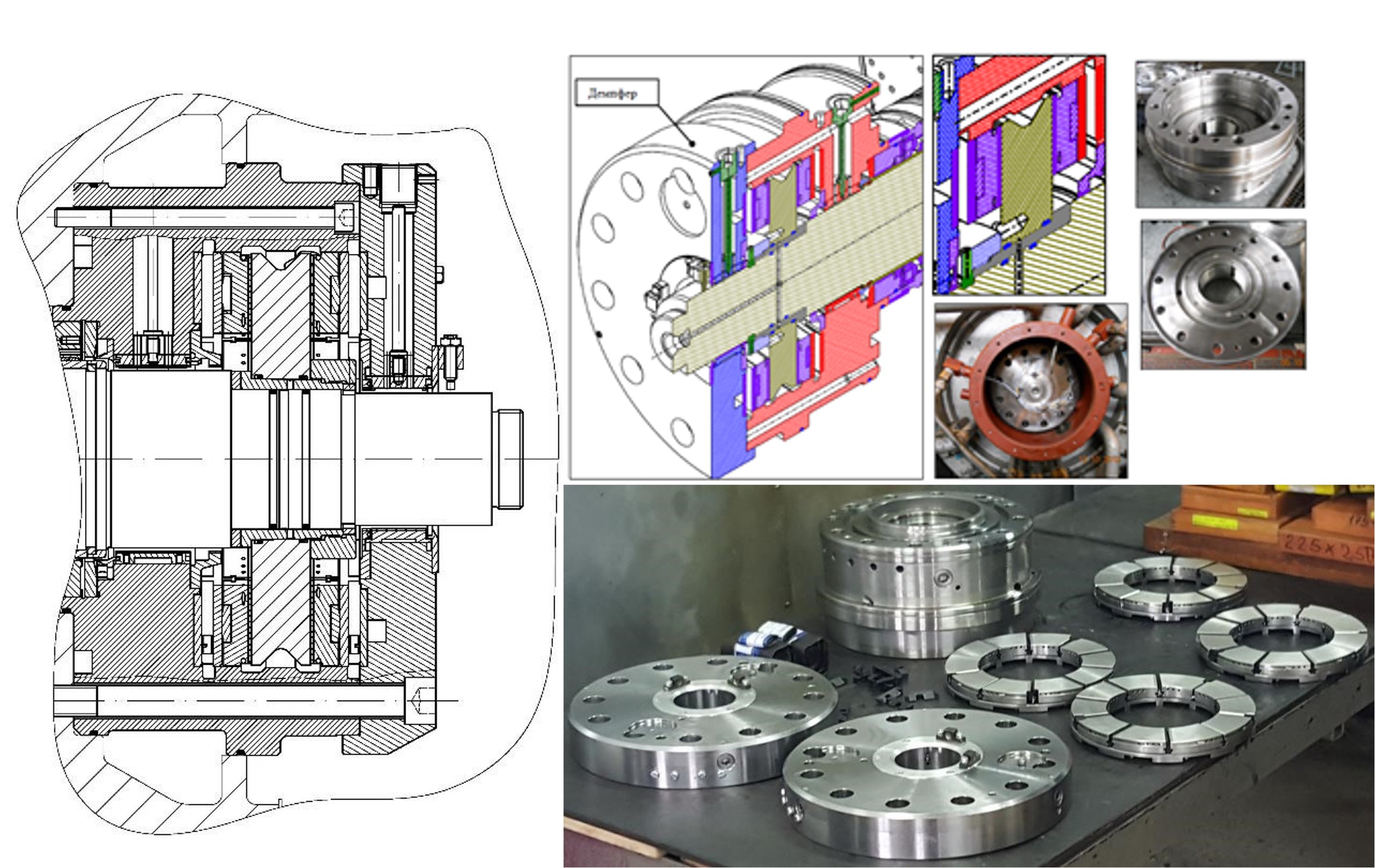
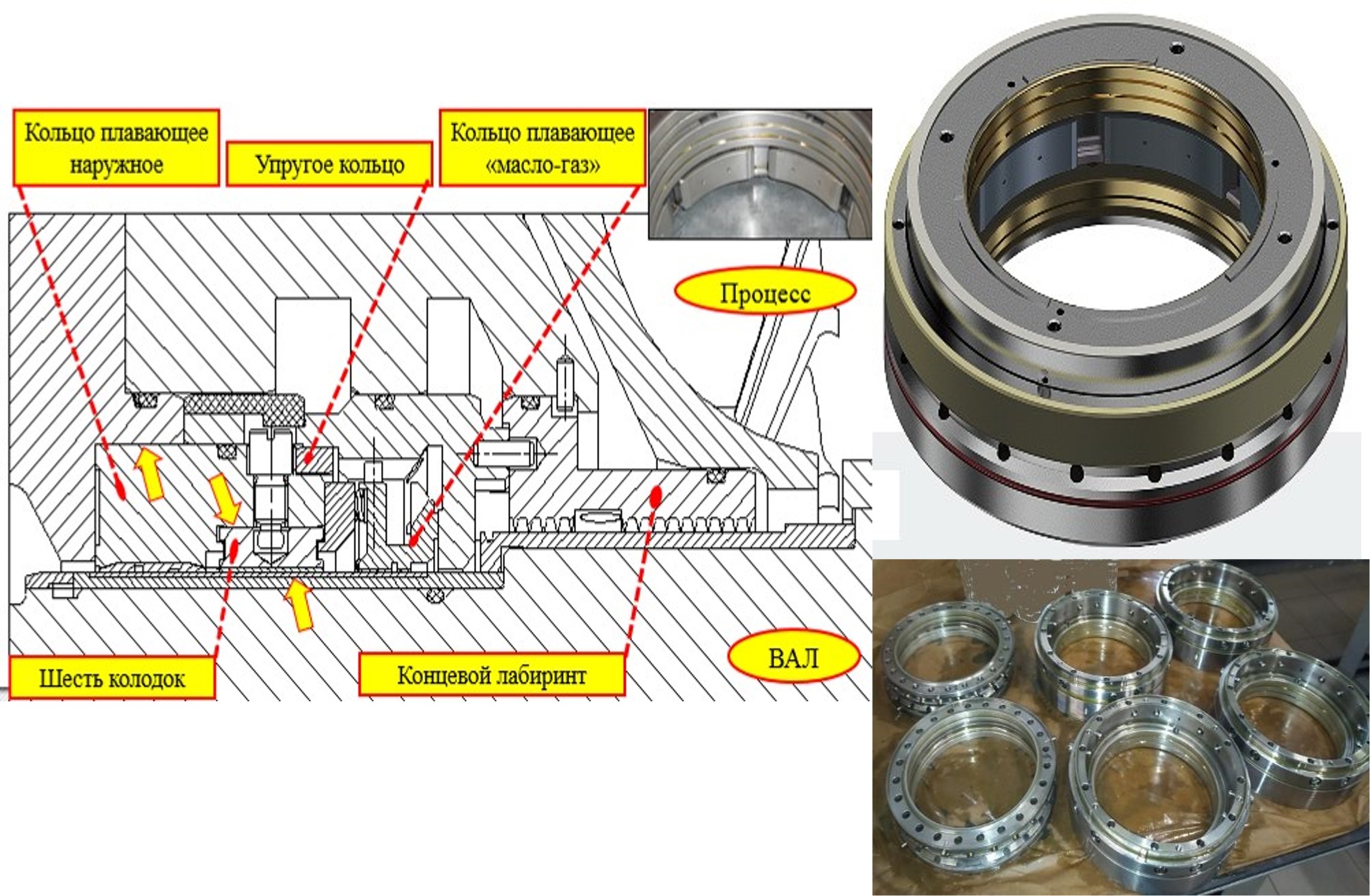
Floating Ring End Seals: Standard floating ring seals were replaced with engineered seals featuring superior load-bearing, damping, and sealing performance.
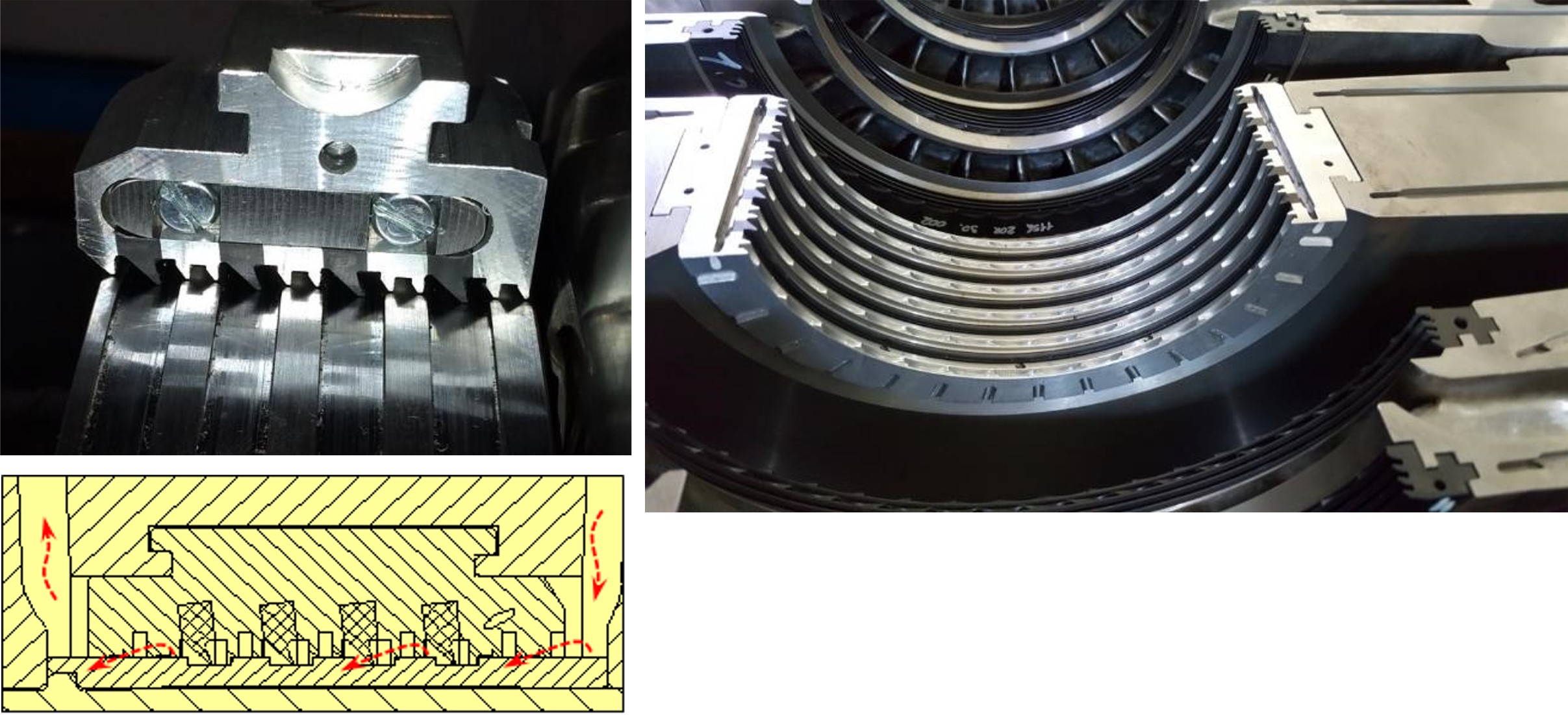
Flow-Path Labyrinth Seals: Standard smooth labyrinth seals were replaced with anti-swirl dimpled labyrinth seals that suppress circumferential cross-coupling forces responsible for self-excited rotor vibration.
Flexible Couplings: Standard gear couplings (LPC-Turbine, Turbine-MPC, MPC-HPC) were replaced with MSK-type flexible membrane couplings engineered by TRIZ, Ltd.
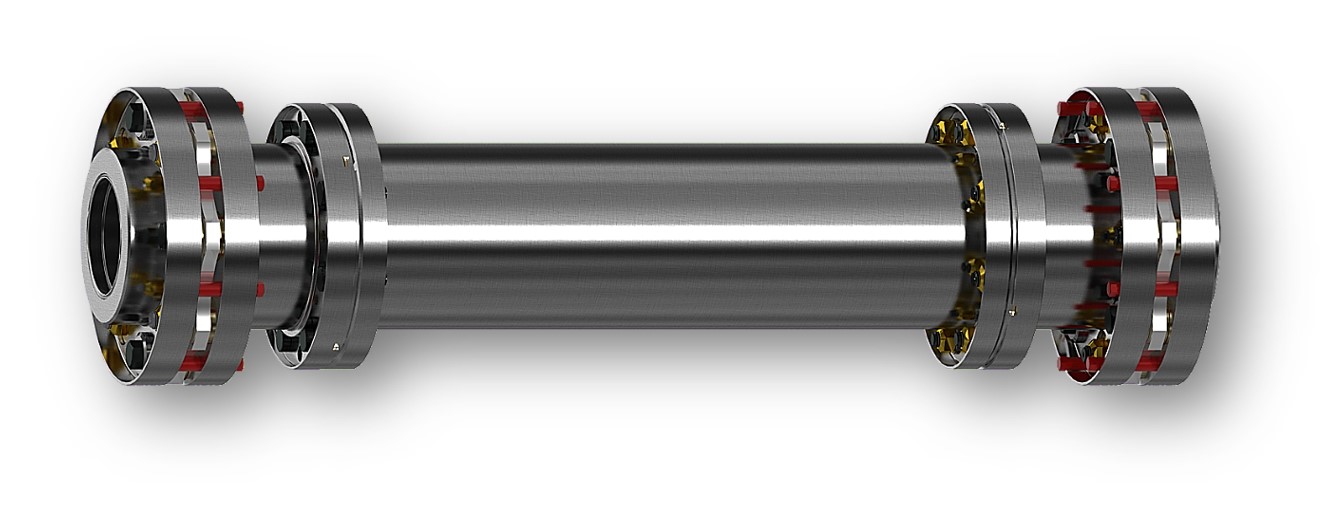
MSK-1600 Coupling (Turbine-MPC)
- • Optimization for Target Output (1,750 t/day): Standard gas-dynamic bundles (internal casings) of LPC, MPC, and HPC were replaced with newly engineered TRIZ® bundles. Flow profiles, blade inlet/outlet angles, and diffuser geometries were custom-optimized to achieve peak efficiency at a baseline output of 1,750 metric tons of ammonia per day.
- • Extremely Broad Stable Operating Envelope: The redesigned TRIZ® flow-path geometry gave the compressor exceptional flexibility. The train seamlessly covers an operating envelope from 1,360 to 2,000 metric tons of ammonia per day without surge risks, allowing plant operators to adapt production rates instantaneously to upstream/downstream demands.
- • Minimization of Internal Losses: Casing efficiency improvements (yielding 3.4 MW in power savings) were achieved by eliminating internal recirculations and neutralizing circumferential swirl forces. Stepped dimpled labyrinth seals suppress gas swirl and establish an effective gas-dynamic barrier, eliminating the need for inefficient external buffer gas injection. The compressor gained substantial dynamic stability margins, peak operating efficiency, and complete immunity to aerodynamic self-excitation.
- • Implementation of Nanoscale Precision Barrel Finishing (Tumbling): Micro-abrasive barrel finishing applied to impellers served as the final enhancement to reach target efficiency metrics. Integrating this process into the manufacturing cycle fundamentally alters flow boundary dynamics.
- • Reduction of Hydraulic Drag (Surface Roughness): During tumbling, impellers are processed in a vibratory-dynamic abrasive medium. This smooths micro-imperfections in hard-to-reach internal flow channels between the hub and shroud. Blade surface roughness drops to a mirror finish (Ra 0.32 … 0.16 µm).
- • Boundary Layer Thickness Minimization: Ultra-smooth blade surfaces minimize gas boundary layer thickness, drastically reducing internal friction and vortex losses, which translates directly into reduced shaft power consumption.
- • Enhanced Impeller Fatigue Strength: Barrel finishing polishes surfaces while gently rounding sharp edges, eliminating local stress concentrations. Simultaneously, it induces beneficial surface compressive stress (shot-peening effect), enhancing blade fatigue resistance against cyclic gas pressure pulsations.
- • Protection Against Contaminant Adhesion: Polished blade surfaces possess extremely low surface energy. Fine catalyst dust carried in the gas stream cannot adhere to mirror-polished blades and is carried away by the flow. This ensures pristine channel geometry and preserves design efficiency throughout the full 2–6 year maintenance run.
Radical Efficiency (COP) Improvement of the Synthesis Gas Turbocompressor Flow Path at JSC “Maxam-Chirchiq” Ammonia Plant
Actual Operational Performance Following Compressor Modernization in the “Ammonia-1” Plant at JSC “Maxam-Chirchiq”
Executing this comprehensive modernization program resolved key engineering, aerodynamic, and process bottlenecks:
1. Ammonia Production Debottlenecking:
- The upgraded Pos. 401 compressor train ensured stable compression of higher synthesis gas throughput, enabling full operational flexibility from 1,360 to 2,000 metric tons per day.
2. Radical Increase in Compressor Polytropic Efficiency:
- Polytropic efficiency at maximum capacity reached the design target of 74%. This was made possible by eliminating parasitic inter-stage leakages and cross-coupling forces through stepped dimpled seals. Tight internal running clearances, maintained by eliminating aerodynamic excitation and maximizing hydrodynamic oil-film damping, served as the foundation for the 3.4 MW reduction in consumed power and confirmed 74% polytropic efficiency.
3. Energy Savings:
- Compressor casing power demand (LPC, MPC, HPC) dropped by 3.4 MW at 1,700–1,750 t/day production compared to pre-upgrade benchmarks. In addition, steam turbine optimization reduced steam demand by 16–20 t/h (averaging 18 t/h), resulting in:
• Substantial reduction in high-pressure steam consumption by the Pos. 103JT drive turbine;
• Proportional decrease in natural gas consumption required for steam generation.
4. Suppression of Cross-Coupling Forces and Catalyst Dust Protection:
- Anti-swirl dimpled labyrinth seals (inter-stage, shaft-end, and balance piston) demonstrated high swirl-cancellation performance with continuous self-cleaning properties. Internal micro-vortices in the dimples prevent dust deposition, preserving clear design clearances and eliminating shaft journal scoring.
5. Extended Run Between Overhauls:
- The modernization program shifted the compressor unit into a stable operating domain, allowing the plant to extend turnaround intervals to 2–6 years of continuous operation without intermediate casing inspections, provided operational guidelines are maintained.
- Through this collaboration, TRIZ, Ltd. and GE delivered a re-engineered, energy-efficient, and robust turbomachine rather than a routine overhaul replacement.
Summary of the Modernization Program Executed by TRIZ, Ltd. and GE at JSC “Maxam-Chirchiq” (“Ammonia-1” Plant)
Dynamic parameters recorded by the online vibration monitoring system on the Pos. 401 compressor train confirm a significant improvement in rotordynamic stability and mechanical integrity.
Measured rotor vibration amplitudes during critical speed transitions (in micrometers, µm):
- 1. Critical Speed Transients (Startup / Coastdown)
• Before Modernization: Standard 5-pad journal bearings allowed severe radial shaft excursion when passing through the first critical speed (4,800–5,300 RPM). Resonant peak vibration jumped to 75–90 µm, occasionally exceeding trip limits of 100–110 µm during poor damping conditions, causing emergency trips, labyrinth rubs, and seal degradation.
• After Modernization: Due to 3-pad squeeze-film damped bearings, resonant peaks were eliminated. Peak vibration during critical transitions does not exceed 22–28 µm, ensuring smooth, stable acceleration through resonance zones. - 2. Steady-State Vibration at Rated Load
At rated ammonia capacity of 1,750 t/day, vibration stabilized at low baseline levels:
• Before Modernization: Oil whirl and aerodynamic swirl inside smooth labyrinths caused persistent low-frequency vibration (LFV), with overall shaft vibration fluctuating between 45–60 µm.
• After Modernization: Stepped dimpled labyrinth seals fully eliminated circumferential gas swirl and destabilizing forces. Stable shaft vibration is maintained within 12–18 µm. - 3. Increased Turnaround Intervals:
With the elimination of rotor excursions and bearing degradation, tight labyrinth clearances are preserved, supporting a 3–5 year operating cycle under standard operating parameters.
Economic Impact of the Synthesis Gas Turbocompressor Modernization at JSC “Maxam-Chirchiq”
Prior to modernization, high-pressure steam consumption (100 atm) by the 103JT turbine was 378 t/h, with a surface condenser flow of 54 t/h at an output of 1,378 t/day of ammonia. Post-modernization steam consumption dropped to 323 t/h, with condenser flow at 52 t/h at an increased output of 1,478 t/day. Accounting for the 16–20 t/h steam reduction from the turbine upgrade, the remaining balance confirms the specific efficiency gains from the LPC, MPC, and HPC compressor casing modernizations.
Thermal and financial balance sheets verify lower overall utility consumption despite higher plant output.
Steam Balance and Output Analysis
- 1. Before Modernization: At a baseline capacity of 1,378 t/day, the compressor train experienced high internal recycling, consuming 378 t/h of 100 atm steam with 54 t/h routed to the condenser.
- 2. After Modernization: Output increased to 1,478 t/day, while total 100 atm steam consumption dropped to 323 t/h and condenser flow decreased to 52 t/h.
Steam Savings Calculation
-
• Total Absolute 100 atm Steam Reduction:
378 t/h – 323 t/h = 55 t/h. -
• Turbine Upgrade Contribution:
Turbine flow-path modernization reduced steam consumption by 16–20 t/h. -
• Compressor Aerodynamic Bundles Contribution (TRIZ, Ltd.):
Subtracting turbine gains from the total balance yields net steam savings from compressor upgrades:
55 t/h – (16…20) t/h = 35…39 t/h.
Financial Impact for JSC “Maxam-Chirchiq”
Saving 37 t/h of high-pressure steam on the Pos. 401 train provides substantial operating margin gains in ammonia production.
Estimated Financial Savings:
- 1. Annual Steam Savings (based on 8,000 operating hours/year):
37 t/h × 8,000 h/year = 296,000 tons of steam per year. - 2. Equivalent Natural Gas Savings for 100 atm Steam Generation:
Generating 100 atm steam (100 ata, 480°C) consumes ~80 m³ of natural gas per ton of steam:
296,000 t × 80 m³ = 23,680,000 m³ of natural gas per year. - 3. Fuel Cost Savings:
At an industrial natural gas price of ~450.00 USD per 1,000 m³:
23,680 thousand m³ × 450.00 USD = 10,656,000 USD/year. - 4. Total Economic Impact:
Combined annual savings from the TRIZ, Ltd. compressor bundles (10,656,000 USD/year) and the GE steam turbine upgrade (5,184,000 USD/year) exceed 15.7 million USD/year in energy inputs alone.
Against an estimated capital expenditure of 5.0–7.5 million USD for compressor bundle replacement, simple project payback was achieved in 7–9 months. - 5. Additional Operational Advantages:
• Extended Run Cycles: Transition to safe 3-year continuous operation between scheduled maintenance overhauls.
• Prevention of Unplanned Trips: Shaft vibration stabilization within 12–28 µm and self-cleaning dimpled seals mitigate risks of emergency shutdowns caused by oil whirl (LFV) or seal fouling, avoiding downtime revenue losses of up to 700,000–900,000 USD per day on AM-76 plants.
• Removal of Summer Steam Bottlenecks: Reducing shaft power demand on the drive turbine eliminates seasonal steam deficits. During high-temperature summer periods when cooling water temperatures rise and vacuum condenser efficiency drops, the modernized train sustains peak capacity (1,750–2,000 t/day), removing seasonal limitations on drive power.
Modernization of the Pos. 401 synthesis gas turbocompressor at JSC “Maxam-Chirchiq” using TRIZ, Ltd. technologies—including squeeze-film bearings, anti-swirl dimpled labyrinth seals, flow-path optimizations across LPC, MPC, HPC, and turbine casings, and impeller barrel finishing—reduced vibration, lowered power consumption, and extended the equipment maintenance lifecycle.
Performance verification test runs conducted by JSC “Maxam-Chirchiq” engineering personnel (see Table) validate the aerodynamic modeling and design solutions delivered by TRIZ, Ltd. and GE.
Operating Parameters of Synthesis Gas Turbocompressor Pos. K-401 at JSC “Maxam-Chirchiq” Ammonia Plant Before and After Turnaround with Replacement of OEM Assemblies and Flow Bundles (LP, MP, HP, and Turbine) with Upgraded Designs.
| Item No. |
Parameter | Tag | Design Norm | Pre-Mod. | Post-Modernization | |||||
|---|---|---|---|---|---|---|---|---|---|---|
| 0 | Measurement Date | 05.03 2022 |
20.03 2025 |
30.04 2025 |
22.05 2025 |
31.07 2025 |
12.09 2025 |
21.10 2025 |
||
| 1 | Liquid ammonia flow from receiver 610, t/h | Q-603 | 57.4 | 61.5 | 64.7 | 63.8 | 62.6 | 64.9 | 63.1 | |
| 2 | Equivalent daily plant load, t/day | 1378 | 1478 | 1553 | 1530 | 1502 | 1558 | 1515 | ||
| 3 | Turbine rotor speed, RPM | S-401/2 | max 11286 | 10660 | 10660 | 10860 | 10900 | 10895 | 10900 | 10906 |
| 4 | Syngas pressure at compressor Section 1 suction, kgf/cm2 | PIRCA-417 | 22-25 | 22.5 | 22.3 | 21.8 | 22 | 22 | 22 | 22 |
| 5 | Syngas temperature at compressor Section 1 suction, °C | T-405-1 | 41-45 | 44 | 41.5 | 41.3 | 44 | 42 | 42 | 40 |
| 6 | Syngas pressure at compressor Section 4 discharge, kgf/cm2 | PN-4 | max 320 | 218 | 234.46 | 234 | 235 | 240 | 239 | 241 |
| 7 | Syngas temperature at compressor Section 4 discharge, °C | T-409 | max 140 | 117 | 117 | 114 | 119.5 | 115 | 118 | 116 |
| 8 | Syngas pressure at recycle stage suction, kgf/cm2 | PC-V | max 290 | 200 | 225 | 220 | 229 | 232 | 230 | 226 |
| 9 | Syngas temperature at recycle stage suction, °C | T-405-5 | 21-45 | 32 | 33 | 28 | 30 | 30 | 29 | 27 |
| 10 | Syngas pressure at recycle stage discharge, kgf/cm2 | PC-N | max 320 | 221 | 231 | 233 | 235 | 239 | 238 | 240 |
| 11 | Syngas temperature at recycle stage discharge, °C | T-410 | max 50 | 37 | 40 | 35 | 37 | 37 | 37 | 35 |
| 12 | Recycle stage differential pressure, kgf/cm2 | dP-410 | max 22 | 16.4 | 16.4 | 16.7 | 16.4 | 16.0 | 16.6 | 16.2 |
| 13 | Compressor Section 1 syngas flow, Nm3/h* | F-401 | min 180000 | 184000 | 187000 | 193000 | 194195 | 197300 | 199000 | 197400 |
| 14 | Compressor Section 4 syngas flow, Nm3/h* | F-403 | min 180000 | 204000 | 205700 | 195300 | 193000 | 197000 | 197000 | 197000 |
| 15 | Recycle stage gas flow, Nm3/h* | F-404 | max 1100000 | 942000 | 937000 | 929000 | 932000 | 946000 | 934000 | 945000 |
| 16 | Anti-surge valve opening, % | FCV-7, 63, 67 | 0 | 0 | 0 | 0 | 0 | 0 | 0 | |
| 17 | LPC thrust/journal bearing rotor vibration, mils | G-401/1/2 | max 3.5 | max 3.5 | 0.66/0.65 | 0.4/0.5 | 0.46/0.5 | 0.42/0.52 | 0.45/0.6 | 0.4/0.6 |
| 18 | LPC journal bearing rotor vibration, mils | G-402/1/2 | max 3.5 | max 3.5 | 0.62/0.71 | 0.51/0.6 | 0.53/0.6 | 0.47/0.61 | 0.53/0.7 | 0.6/0.53 |
| 19 | MPC journal bearing rotor vibration, mils | G-403/1/2 | max 3.5 | max 3.5 | 0.45/0.48 | 0.45/0.62 | 0.64/0.6 | 0.43/0.62 | 0.53/0.3 | 0.4/0.6 |
| 20 | MPC thrust/journal bearing rotor vibration, mils | G-404/1/2 | max 3.5 | max 3.5 | 0.46/0.46 | 0.87/0.42 | 0.83/0.4 | 0.84/0.38 | 0.76/0.5 | 0.4/0.78 |
| 21 | HPC journal bearing rotor vibration, mils | G-405/1/2 | max 3.5 | max 3.5 | 0.75/0.84 | 0.65/0.4 | 0.64/0.3 | 0.62/0.38 | 0.64/0.3 | 0.4/0.74 |
| 22 | HPC thrust/journal bearing rotor vibration, mils | G-406/1/2 | max 3.5 | max 3.5 | 0.85/0.8 | 0.61/0.3 | 0.47/0.3 | 0.56 | 0.53 | 0.3 |
| 23 | Turbine journal bearing rotor vibration, mils | G-407/1/2 | max 3.5 | max 3.5 | 0.44/0.97 | |||||
| 24 | Turbine thrust/journal bearing rotor vibration, mils | G-408/1/2 | max 3.5 | max 3.5 | 0.95/0.91 | |||||
| 25 | Steam pressure at turbine HP inlet, kgf/cm2 | P-450 | 95-105 | 100 | 102 | 104 | 105 | 105 | 103 | 106 |
| 26 | Steam temperature at turbine HP inlet, °C | T-440 | 470-490 | 474 | 490 | 500 | 495 | 500 | 501 | 498 |
| 27 | Steam extraction pressure, kgf/cm2 | P-456 | 37-40 | 39.5 | 38.94 | 39.4 | 38.5 | 39.4 | 39.6 | 39.5 |
| 28 | Steam extraction temperature, °C | T-442 | 360-380 | 338 | 356 | 367 | 364 | 365 | 380 | 376 |
| 29 | Steam pressure at turbine LP outlet, mm Hg | P-458 | -412-500 | – | -324 | -327 | -313 | -312 | -310 | -302 |
| 30 | Steam temperature at turbine LP outlet, °C | T-1 | 65-85 | 99 | 82 | 88 | 84 | 82 | 81 | 75 |
| 31 | Steam mass flow at turbine HP inlet, t/h | F-410 | max 355 | 378 | 323 | 321 | 316 | 314 | 320 | 315 |
| 33 | Condensate flow from condenser, t/h | F-412 | max 75 | 54 | 52 | 58 | 61 | 57 | 59 | 67 |